Tuesday, June 12, 2012

Holy Garbage!

I am appaled on a daily basis by the pollution in this city - and I don't even really care about the environment. People literally live in mountains of garbage, there is a constant layer of smog, and open sewage is a common sight.  Occassionally, I get stuck behind a garbage truck and I think "Really? What's the point?" I have come to the conclusion that being a garbage collector in Luanda must be the worst job on the planet. It seems like an insumountable task. Last week, a large pothole emerged outside my house, and it was immediately filled with trash by the following morning. There were bicylcles, boxes, small creatures, you name it. I mean, where did all that stuff even come from?
I have to assume that part of the problem is that this city was built to accomodate 1 million people but is now home to 8. The other problem is the human factor. In general, people here have very little respect for their environment. Littering is rampant and so is excess use of electrcity and gas (if you have it). Eventhough is't about 90 degrees here, I am constanrly shivering because anyone who has an air conditioner feels the need to have it on full blast all the time - just because they can. I suggested to my co-workers that we turn the AC off when we leave at night, which did not go over well. This one might be a losing battle.
An Angolan kid over the garbage, picture taken by Jose Paulo 23 December 2009

Saturday, June 2, 2012

Culture Clashes


Whether teaching abroad or in the States, I have always enjoyed picking up tidbits of cultural knowledge through conversations with my students. It’s one of the best parts of my job and keeps me endlessly entertained.  

Last week, we were studying physical descriptions of people. One category was age, so we were using the adjectives young, old, and middle-aged. One student asked the meaning of middle-aged and I told him about 45-65. Then another student asked, “Well, in Angola, is middle-aged different? Because people here usually die before 65.” Awkward!


In another class, we were studying food. In groups, students had to think of a food for each letter of the alphabet. I noticed that the groups were engaging in heated debates and began asking me questions in order to put the argument to rest. “Are tomatoes food?” Yes. “Is a banana food?” Yes. “Are carrots food?” Yes.
Okay, this was getting weird so I stopped the game and asked the class, “Is lettuce food?”
Everyone replied, “No.”
“Ummmmm, then what is it?”
“A vegetable”

Apples are NOT food!
After much discussion and confusion on my part, I discovered that Angolans only consider something food if it is cooked or prepared; therefore, a banana is not food, it’s a fruit. I explained to them that for the purpose of this class, we will consider food all the things that we eat, to which someone responded, “but you can eat anything.” Ugh.

I also learned that if an Angolan doesn’t eat the typical food for a meal, he will say, “I didn’t eat” even if he did. For example, everyone eats tea and bread for breakfast, so if someone eats cereal and is asked, “What did you eat for breakfast?” He will respond, “Nothing. I just had cereal.” Same for lunch. If he doesn’t eat funje (the gray blobby stuff), but instead has a sandwich, he will claim that he didn’t eat. This really threw a wrench into my lesson.

*Upon learning that we don’t have funje in the US, some of them are reconsidering their dream of studying there, because they “can’t even survive one day without funje.” 


I am teaching two courses in academic writing, and one of the major obstacles is the stylistic difference between Portuguese and English. Written Portuguese tends to be flowery and indirect, while written English is considered more effective when it's clear and concise. I always tell my students, "don't use 10 words if you can use 5." Here is a prime example. This is an e-mail I received from a student last week. 

Professor Nee, 
Receive my regards at any time you are going to read this email, and I wish  this to find you in a good health. I came through this message to know how is your health, as we you told us that you would travel and we would not have class on Monday, so We missed you that is why it encouraged to write you and know your disposition and how is your maintenance in South Africa up to now. 
Professor It was only this that troubled me to know how you are, knowing that you have been very kind with us every time, and we have also lived in a very good brotherhood so we can't stay like this without know at least your disposition and you to our as well. That's why wherever you are my best wishes will trace you the steps.
I finish here.

Your Student,
XXXXXX


Wednesday, May 23, 2012

Lar Kuzola

Seven years ago, my life was changed forever when I met the most resilient and amazing children in the world. While studying abroad in Cape Town, I volunteered at Baphumelele Children’s Home, which is located in the largest township in the city. Townships are informal settlements in which people literally live on top of one another in tin shacks. There are no municipal services like electricity, water, or plumbing. Violence, extreme poverty, and disease run rampant.  Amidst this bleak scene, stands a miraculous place full of love, laughter, and generosity. I can remember driving there for the first time with a pit in my stomach and thinking, “I’m going to see orphans in Africa. This is going to be so depressing.” It was anything but. The children swarmed me as soon as I got out of the car, each one wanting a hug or to hang from one of my limbs.  The caretakers were singing to the babies and washing clothes, while the toddlers played at their feet. In the middle of this terrible place, the women there had created a safe haven where the joy was palpable. This experience taught me that children don’t need much to feel happy and loved, and all it takes are a few dedicated individuals to give them that.

* My parents still continue to generously support Baphumelele Children’s Home, which is run by CHOSA Children of South Africa


Shortly after I arrived in Luanda, my friend Melissa, who is the Community Liaison Officer at the Embassy, told me about an opportunity to volunteer at a local orphanage. I jumped at the chance. 
Lar Kuzola, which means “love” in Kimbundu, a local language, is in the heart of Luanda. The children, who range from infants to teenagers, have arrived at Lar Kuzola for a number of reasons. Some have been abused, abandonded, or neglected by their families. Others have lost their parents to disease or violence, while others have severe mental or physical disabilities that their families could not cope with. Perhaps the most distrurbing reason why some children end up there is witchcraft. Witchcraft is still a very prominent aspect of Angolan culture, even in urban areas. Many times, children are accused of being witches if the parents are experiencing hardship. They will go to a “priest” and ask why such terrible things are happening to them, and the “priest” will blame it on their child who he claims to be possessed.

Warning:  this article may cause you to lose all hope for humanity Angolan Witchcraft's Child Victims

Unfortunately, my first visit to Lar Kuzola, was nothing like my experience at Baphumelele.  Due to lack of funding and volunteers, the facility, which is home to about 250 children, is severely understaffed. It’s somewhat of a free-for-all in which the children roam about doing their own thing, without supervision or structure. Anyway, I met with the director, who asked me if I would like to get involved with a pilot English program for 15 children. Since I am pretty busy these days, I was thinking I really don’t have time to teach myself, but I could ask some of my English students at the university if they would be interested. Voila! The idea for the Lar Kuzola Student-Teaching Program was born.
Since many of my students at Agonstino Neto University are aspiring teachers, I thought this would be a great opportunity for them to get some hand-on experience while at the same time providing the kids at the orphanage with English lessons. Everybody wins!
The response from my students, who are now the student-teachers, has been amazing! I have been really impressed with their dedication. We have been holding the classes on Saturday mornings for the last few weeks and I hope that this will continue indefinitely, even after I leave in December. 
Best of all, when I am in that classroom, I get that old feeling back again. The way I felt at Baphumelele. And I can tell that the student-teachers feel it too. 
Ball toss - always a crowd pleaser


Tuesday, May 15, 2012

Life's Little Pleasures


A collection of things I miss about good ol' USA (in no particular order):

* Family and friends are a given, so this list excludes people
  • Walking
  •  Food that tastes good
  • Running water at my place of employment
  • A general understanding that urinating in public (unless highly intoxicated at 2am) is socially unacceptable
  • Not thinking I have malaria every time I get a mosquito bite
  • Vegetables
  • The unspoken rule that throwing your garbage anywhere and everywhere is not OK
  • Toilet paper, soap, and indoor plumbing in public restrooms
  •  Working at a functional institution
  • Reasonably priced cocktails
  • TV that has more than 6 channels in English
  • Reliable electricity
  • What's this?
  • Not spending at least 3 hours in the backseat of a car every day 

On the bright side:

  •  Considering all the time I spend in the car, I am reading a book a week and listening to many informative podcasts
  •  I am learning a new language
  • My students think I invented games like charades and pictionary, and therefore believe me to be a creative genius
  • I am very hard core now


Coping with the boredom


            Seeing as entertainment options are limited in Luanda, and since there are approximately 8 people under the age of 35 in my social network, I have begun to engage in some activities that are slightly inappropriate for my age. I am currently participating in a book club, a knitting group (I do not know how to knit), and a water aerobics class. By the time retirement rolls around, in about 35 years, I’ll be an old pro.
On the flip side, my favorite solo activity is coloring. I print out pages from coloring books online, throw on some tunes, and just go to town. I find it to be very therapeutic. In addition, my beautiful works of art make wonderful gifts and are a cheap and cheerful way to spruce up the bare walls in my room.


Side notes

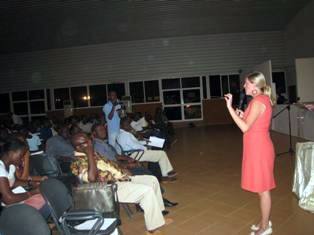
            Last week, I gave a presentation to 150 English students at Utanga University. In case you were wondering, it was called “Strategies for Improving Prounciation & Vocabulary.” Surprisingly, this was not the highlight of the evening. Musical and theatrical performances are a staple of academic and professional conferences here, and this one takes the cake so far. A male college student performed the power ballad, “Because You Loved Me,” by…..you guessed it! Celine Dion. Karaoke aside, it was by far the worst vocal performance I have ever heard.

 The guy in the front row is sleeping. He is my boss.


            Today, in class, we played Celebrity Dinner Party. Groups had to agree on a guest list of 10 celebrities, living or dead, to invite to a dinner party. Since I am “a very famous English teacher,” one of the groups invited me to their party. I was very honored, considering the other guests included Osama bin Laden, Phil Collins, Kobe Bryant, and Kim Kardashian. Sounds like a pretty good time. 

"Whoa Whoa Whoa! Who invited Kim Kardashian?"

Wednesday, May 9, 2012

Keeping Things in Perspective


           Remembering that this country is still recovering from a devastating civil war that ended only 10 years ago and that its people are plagued by crime, disease, and economic hardship, is not always easy.  The daily frustrations of working within a system that doesn’t make any sense and having to work collaboratively with people from a completely different world, can sometimes blind us from seeing the reality and the suffering that exists in this place.   
 I am often reminded how fortunate I am and how my “problems” don’t even begin to compare to those of the Angolan people. A co-worker tells me he won’t be in tomorrow because his 9-year-old nephew died of malaria and he needs to attend the funeral. A friend is robbed at gun point and when I console her, she says, “I didn’t even cry. It’s normal here.” A student, who clearly has polio, apologizes for being late because he was at the hospital.  Suddenly, the fact that the Internet at my house has been down, doesn't seem like such a big deal. 
In spite of the tragedies, work still has to get done, and so I must somehow find a balance between being compassionate and being assertive. Just recently, I went to Cazenga to work with a class there. The teacher didn’t show up and attendance was very low. This particular visit was unannounced so I became concerned that this was the norm and that when I tell them I’m coming, the teachers put on a show. Since this program is supported and funded by the US Embassy, I reported the incident and the teacher’s supervisor was notified. I found out a week later that the reason the teacher was absent was because his young niece had died and the body was lost, so the family was scouring the city’s hospitals and morgues looking for her. So now I feel like a big jerk! But of course, how could I have known that?
The truth is that sometimes people don’t show up for work or school for no reason at all, or they don’t perform jobs that were assigned to them and they have no viable excuse. Like my students always blaming their tardiness on traffic. It is true that this city’s traffic is horrible. It can take 1 hour to travel 5 miles. So of course people are late due to traffic, but it’s part of life in Luanda, and it can’t be used as an excuse everytime one does not fulfill an obligation. I have no way of knowing if a student is late or absent because of some extenuating circumstance beyond their control, or because he overslept, so what do I do? The only fair and logical thing to do is to make the rules the same for everyone and to not accept any excuses. It’s harsh, but so is everything else here. 

Wednesday, April 25, 2012

A Smorgasbord of Personal & Professional News

University Life

            Classes finally started (about a month and a half late) at the university. I’m enjoying being in the classroom again, but it does not come without its frustrations. This is definitely my most challenging teaching situation to date, mostly due to the lack of materials, class size, and general dysfunction of the administration. Let’s be clear here: This institution does not at all resemble an American university. Just to give you an idea, I asked the head of the English Department for a class roster and he looked at me like I had 3 heads. I have on average about 30 students on each of my four classes, but I am told that there should be more like 50. I really have no idea if the people sitting in front of me should be there or not.  I have come up with a strategy for situations such as this — “laugh it off and improvise.” I have to constantly remind myself that this is not the US.
            Being with the students is by far the best part of my job. My students are respectful, motivated, and receptive to me. The students are used to a very passive, rote style of teaching, so I have been impressed at how easily they have adjusted to my method, which is much more interactive. Upon meeting new students, their first question for me, without fail is, “Are you married?” More accurately, “Is the professor married?” Yes, they speak to me in the third person. This is how you show respect in Portuguese, but in English it’s totally weird. We are working on it. Anyway, when I answer, “No,” their follow up question is always “Why not?” What they’re really asking is. “What’s wrong with you?” I still haven’t come up with a clever response to this inquiry. Usually, I just shrug and say, “I don’t know. I’m just not,” and then feel really bad about myself for like 15 minutes.
            Tardiness is epidemic in Luanda, and the university is no exception. Culture, as well as the ridiculous traffic jams, are the major contributors to this problem. I decided to nip this in the bud, because if there is one thing I do not tolerate, it is tardiness. I instituted a very strict lateness policy, which was met with shock and appall. I’m pretty sure no one has ever tried to do this in the history of the Angolan education system. I like to think of myself as a trailblazer. Much to my surprise, the policy is actually having a positive effect on their behavior. I have far fewer late students, and when they do show up late, they are terrified to enter. Success!
            One other problem is that the courses I have been assigned to teach are not appropriate for the English level of the students.  Luckily, there is absolutely no oversight within the department so I pretty much do whatever I want. For example, I teach a course for the 4th year students (Seniors) entitled “Thesis Workshop.” I was instructed to teach them how to conduct research and compose a thesis. Right now, we are working on writing complete sentences. Clearly, there is somewhat of a disconnect between the skills and needs of the students and the expectations dictated by the administration. Again, “laugh it off and improvise.”

ANELTA (National Association of English Language Teachers of Angola) Conference

Last weekend, I was invited to give a presentation to about 60 local English teachers. My presentation was called “5 Tips for Creating a Student-Centered Classroom.” I assume it was riveting.  


Cazenga

            I’ve been working with the high school students in Cazenga regularly, and it is quickly becoming my favorite part of the week. Amidst the poverty and suffering, these kids offer a ray of hope. They make me feel like maybe everything won’t suck forever.
            The students came to the Embassy today for a tour and a Q & A session with the Ambassador. They asked questions like, “What can we do as students to improve our country? and What do you think about gender equality?” Pretty impressive. On Friday, I am taking two of my students at the university there to speak with them about continuing their education and studying English at the university level.

Easter Party

Party planners


 I helped organize the Easter party at the Embassy a few weeks ago. We had an Easter egg hunt, egg on a spoon races, egg toss, and arts and crafts. The kids had a really good time playing on the Embassy lawn, which I am pretty sure is the largest area of grass in Luanda.


Egg on a spoon

Birthday Festivities

            I have to say that I could never have imagined that I would be celebrating my 27th birthday on a rooftop in Angola, but that is exactly why I have chosen this life of adventure. My housemates and I had a BBQ complete with a DJ, rain, and hookers.
What?! Allow me to explain. An unfortunate reality of expat life here is that many of the men are not faithful to their wives back home. They often have Angolan “girlfriends,” who they provide for financially. They don’t speak the same language so I assume that they are not connecting on a deep, intellectual level. At best, these types of relationships are mutually exploitative; at worst, prostitution. Anyway, they know how to have a good time and they really brought a certain something to my birthday party, so no judgment.
     
On my actual birthday, I took off from work a little early and went to the beach, then out for a fancy dinner. Not a bad way to start the 27th year of my life. I have a feeling it's going to be a good one...

This event was also a going away party for my housemate, Andy

Dance party in the rain

Embassy friends

What's a BBQ without a few DJ's?


Birthday dinner

Rasta Party at the Marine House

No explanation necessary. 


Wednesday, April 11, 2012

Alambamento or Bizarro Wedding

Last Saturday, my colleague, Rocha, invited me to his alambamento, or traditional Angolan wedding, which turned out to be one of the most fascinating cultural experiences I have ever had...and an awesome party!

Getting there was half the battle:

2 weeks before the wedding, Rocha invited me and I accepted. He gave me the date but wasn't sure about the time yet. Fine. As the days go by, I ask repeatedly what time the ceremony starts and what I should wear. The answers usually went something like this, "Oh Brigid, you can do whatever you want!" Not helpful. Finally, 2 days before the wedding he tells me it starts at 4:00. "Does it really start at 4:00? Or is that Angolan time and it's actually going to start at 6:00?" I ask him, "Oh no! It definitely starts at 4:00," he assures me. OK, we'll see about that.
I got some mixed messages about the dress code as well. Rocha told me I could wear a suit (not happening) and my female co-worker told me she was going to wear jeans. Again, not helpful.
On Friday afternoon, Rocha calls me to tell me that the ceremony will now begin at 3:00 but if I want I can meet the bride (who I don't know) and her family at her house and go with them. Uhhh, no thanks. I schedule the driver to pick me up at my house at 4:00 because I know that there is no possible way this thing is going to start on time. Learn and adapt.
I didn't know exactly where the hall was so my other co-worker told me to have my driver call him when we were on the way. Of course, when I called him his phone was not in service (that happens a lot, especially when you really need to speak with someone). I called another co-worker but she didn't know where it was either. "Just call Rocha and ask him," she says. Are you serious? It's his wedding day! Left without options and an annoyed driver, I reluctantly called Rocha, who was happy to give directions. Rocha instructed me to wait in the car until he arrived. Note at this point, it's about 4:45, remember when he told me it started at 3:00? I got to the hall and waited about 30 more minutes for him to arrive. Finally, around 5:30, his friend escorts me up to the room where the meeting of the families is about to begin....

10 cases of beer and a pant suit:

This is where it gets interesting. Rocha's friends and male family members start lugging cases of soda and beer into the room and placing it in the space between the two families. The guest next to me informs me that these are the gifts being offered to the bride's family. So I guess this is the going rate for an Angolan bride these days. Once all the gifts are in place, the bride's uncle reads a list of the items while the groom's uncle presents them. This list has already been agreed upon prior to the ceremony, so this is a way to prove that the groom has indeed purchased the necessary gifts. Also included were shoes for the bride's father and a pant suit for her mother.


 After this, the groom enters the room, while the bride is still in an undisclosed location. Now the families must decide on a date for the casamento, which is the legal wedding. In this case, the bride, Marcia, is pregnant, so her family would like the official wedding to be sooner rather than later. The groom's family, who just shelled out big bucks on beer and soda and who also need to pay for the casamento, would like to push it back a year. This results in a disagreement that required the aunts and uncles of each family to discuss it among themselves and then report to the other side. It looked something like this:


This process took about 40 minutes and it was fairly tense at times. They decided to have the legal documents in the next 2 months, but wait one year until they have the party. Everybody wins as I see it. Now it's time for the bride to join us. Plot twist! 2 women about the same shape and height walk up the stairs covered in sheets. Rocha must choose which one is Marcia. At this point, the mood is very light and the guests are shouting at him about who to pick.
He got it right!


The couple kissed and exchanged rings and we all shared a champagne toast. Rocha's uncle gave a beautiful speech and at the end motioned for me to stand up. What??? Mind you, I have never met a single person in this room aside from Rocha. I awkwardly stand up and wave at everyone as the uncle explains that I work with Rocha at the university and that I am American. I can immediately feel the confusion lifted from the room, as I can imagine everyone up to that point was thinking, "Who is this white girl and what is she doing here?"

Once all the business was taken care of, we all moved downstairs for the party. In typical Angolan fashion, there were exorbitant amounts of food, drinks, and dancing. These people definitely know how to have a good time. Rocha's brother explained to me that since life is so hard and you never know what will happen tomorrow, they have to celebrate the joyous moments when they can. And celebrate we did....


The Newlyweds - Marcia & Rocha