Wednesday, April 4, 2012

Happy Peace Day!

Angola: Mixed Progress After Ten Years of Peace

When stunned Angolans picked up their copies of Jornal de Angola in February 2002 to see the bullet-riddled body of UNITA rebel leader Jonas Savimbi, many immediately knew that the long years of war were over.
The conflict, which first erupted upon independence from Portugal in 1975, was about many things. It was a war of UNITA's oppressed rural peasants against oil-rich, predominantly coastal and urban élites. It was a struggle between different ethnic and geographical groups; and it was a proxy war pitting the United States and Apartheid-era South Africa against the Soviet Union, Cuba and its allies. It was even a war of minerals, with oil underpinning the army of the ruling MPLA, while diamonds fed UNITA. Most fundamentally, though, it was a war of ambition by Jonas Savimbi, whose dream was to rule Angola, no matter what the human cost.
When Savimbi died, Angolans had seen too many false starts, and most were too cynical about the MPLA leadership to get too excited about the future. But then there was, of course, the oil: three quarters of a million barrels per day (bpd) back then, with a bevy of billion-barrel deep water oilfields in development. Production rose steadily, and today stands at over 1.8 million bpd, making Angola Africa's largest producer after Nigeria. The government has splurged on infrastructure, helped by large loans from China and other friendly governments, and in 2010 The Economist gushed, in an article entitled 'Angola Rising: Oil, Glorious Oil', that 'the country's breakneck growth is slowly benefiting the masses.'
The surface signs of development are indeed striking: the shiny and vibrant nodes of prosperity in Luanda today bear little relation to the shabby, unkempt and raucous city of cold showers, warm beer and shortages that I knew and loved while serving as Reuters' Angola correspondent nearly 20 years ago.
Politically, however, the changes are less impressive. A few days ago an IMF report said something that could have been written back in 2002: that the authorities 'have begun to phase out quasi-fiscal operations by Sonangol, the state oil company, and are incorporating them into the budget.' This lack of progress is apparent elsewhere. A highly controlling, rather secretive government under the ageing José Eduardo dos Santos has dominated the political scene since the war ended, and, true to old form, has recently been violently cracking down on protesters and intimidating journalists.
When it comes to the ordinary lives of ordinary Angolans, a more troubling picture emerges.
One of the more unusual indicators provided by the United Nations Human Development Index is called 'GNI per capita rank minus HDI rank,' on which oil-rich Angola has a score of minus 38, among the world's worst. This number tells us that Angola's human development indicators - which indicate how well ordinary folk are faring - lag remarkably far behind where they should be for a country with so much money. For all the outward signs of progress, Angola is not harnessing its oil to make its people's lives better. (All the countries with worse scores in this particular respect are minerals exporters.)
Ten years after the war's end, Angola appears to remain a poster child for the 'resource curse'. Life expectancy at birth, at 51.1, puts it at 181st place out of 187 countries ranked. Adjust the figures to take account of inequality, and Angola slips three places further down. On the poverty statistics Angola ranks almost as badly. Politically, Angola remains rather authoritarian.
Angola may be peaceful and even, up to a point, rich. But ordinary Angolans are still waiting for their peace dividend.
Nicholas Shaxson is Associate Fellow in the Africa Programme of Chatham House.

More news about Angola:

Monday, April 2, 2012

One Month In

Random thoughts about my first month in Angola:
·  I completely understand why everyone I met when I first got here told me to “be patient.”
·  Note to self: Do not, under any circumstances, marry anyone in the oil business!
·  If you ask 5 people the same question, you will get 5 different answers and end up more confused than when you started. I have decided to succumb to my daily bewilderment about everything that is going on around me.
·  I am keenly aware of my whiteness everywhere I go.
·  Angolans believe me to be extremely privileged and wealthy.  I am not at all comfortable with this assumption, which is based entirely on my appearance, but I understand it. I recognize the immense disparity between my lifestyle here and that of most of the local people.
·  People don’t go to work or school when it rains. This was also true in Costa Rica and Nicaragua, so it doesn't come as a shock, but it also doesn’t make it less annoying.
·  Every time I ask a group of high school students which American singers they like, a teenage boy inevitably yells out “Celine Dion!”
·  Most of the Angolans that I have met realize that things are pretty messed up here, but feel powerless against the authoritarian government and its control over the resources and economy.
·  I have come to the conclusion that African women possess some sort of genetic advantage which allows them to carry massive amounts of stuff on their heads.
·  Going out for dinner usually leads to spending $50 on a mediocre meal.
·  Having a driver was at first very exciting, but is now getting a little old. I'm still getting used to the idea that I have to schedule everywhere I go at least a day in advance.
·  The streets and beach are used as public restrooms.
·  I live across the street from the beach but have never been there (see above).
·  Angolan people speak louder than anyone I have ever encountered.  What are you yelling about? Relax.
·I wish the cleaning lady would stop stealing my bananas.
·  The students all stand when I enter the room. It makes me feel very important and embarrassed all at the same time. 


Tuesday, March 27, 2012

Sometimes I work...

Working hard at my fancy desk
It hasn't been all parties and stomach aches over here. Believe it or not, I have been working, and I have a picture to prove it.

While things at the university have been a bit slow, I have managed to keep myself pretty busy. Today I even had 1 student show up for class! Mark one in the win column.

A few weeks ago, I helped organized a webinar at the Embassy for local English teachers. About 20 teachers participated in a worldwide, interactive seminar.
Webinar at the Embassy


Teaching Access students

playing a vocabulary game
Look how much fun they are having!

I have also been working with the English Access Microscholarship Program at a high school in Cazenga, which is a pretty rough neighborhood outside Luanda. The kids there have really impressed me with their enthusiasm for learning and I'm really enjoying working with them.


*The English Access Microscholarship Program (Access Program) provides a foundation of English language to talented 14- to 18 - year-olds from economically disadvantaged sectors through after school classes and intensive summer activities. Participants gain English skills that may lead to better jobs, educational prospects, and increased opportunity to participate in future exchanges. Since its inception in 2004, over 70,000 students in more than 85 countries have participated in the Access Program.


Monday, March 19, 2012

Happy St. Patrick's Day!

Spreading a little Irish cheer in Africa...


 St. Patty's Day party at the Marine house

 
My Angolan friends didn't wear green. How embarrassing!

By the way, classes at the university were supposed to start 2 weeks ago, yet I haven't seen a single student. We are "easing our way into the semester."

Monday, March 12, 2012

Food Dilemmas

One of my biggest challenges since I arrived has been finding edible, reasonably priced food. Many of the Americans here ship boxes of food before they arrive, and now I understand why.

Due to the devastation caused by the civil war, Angola produces next to nothing. Farmland has been destroyed and littered with landmines and roads outside of Luanda are so poor, that it is almost impossible to transport products into the city. Therefore, almost everything in the grocery stores is imported, making it incredibly expensive and of poor quality.

I have tried a couple different grocery stores because I've been told that the quality and variety of food is hit or miss. So far, it's been a miss. I usually walk around the produce section for a solid half hour searching for anything that looks remotely enjoyable, with little success. For sanitation reasons, it's best to follow the "peel or cook" rule, which can also be limiting. Some people wash fruits and vegetables with a bleach solution, but I think that's gross.

I keep asking Angolans where I can buy fresh vegetables and fruit, like in an open market or on the street, but they are convinced that my 1st world stomach can't handle street food so they simply refuse to give me any information. So finally I made my driver stop the car because I noticed some women selling delicious-looking fruit on the side of the road. Before I knew it, I was bombarded. I spent $40 and ended up with I think 38 oranges and 12 avocados. I've been eating roughly 3 oranges per day. I'm still working out the kinks in my system.

On the bright side, I made a wonderful guacamole for our BBQ on Saturday night!

 On Friday afternoon, my Angolan co-workers reluctantly invited me to join them for lunch (not because they don't like me, but because they didn't think I would enjoy their usual lunch spot). Boy, were they wrong! We walked across the street to a modest "restaurant" which consisted of a sheet held up with wooden poles and 2 plastic tables inside. Outside, there was a grill with whole, fresh fish sizzling. I was served a heaping plate of beans, cassava greens, fish, and funje by a smiling, plump woman who anxiously awaited my reaction to her cooking. It was by far the best meal I've had since I've been here and it was only $5!


Enjoying a traditional Angolan meal with my co-worker, Djamila


My new lunch spot
* Funje (the white blob in the photo) is a staple in Angola and is a thick porridge made from manioc (yucca) flour. It doesn't have a strong flavor and is used mostly to soak up sauces, but the texture is a bit rubbery and it sometimes has a gray-ish color, which is off-putting to most foreigners
                    

Monday, March 5, 2012

KUDURO!!!

Kuduro literally translates to "hard butt." It's a musical style and dance that originated in Angola in the 1980's. I got my first taste of this lively tradition on Saturday night. Nadya, a former student of mine and native of Luanda, invited me to a family party.

Sidenote - This was also my first experience with "Angolan time." The party started at 2pm, Nadya told me she would pick me up at 3, she got to my house at 6, we arrived at the party at 7, and we weren't considered late. As one of my Angolan co-workers pointed out today, it's surprising that in a country where the life expectancy is 55, people think they have all the time in the world.

I took this video at the party. I call it "The Angolan Electric Slide"


Here is one of the most popular Kuduro songs and the most ridiculous music video I've ever seen.


Saturday, March 3, 2012

First Impressions

"If you can make it here, you can make it anywhere"

This is the general sentiment among both locals and expats here. Because living and working in Luanda can often be challenging, there is a strong sense of community among expats. I have received a tremendous amount of support from the staff at the US embassy and my housemates as I navigate life in this crazy place.


Chamber of Commerce of Angola event last night. I met the US ambassador to Angola and several big players in the oil industry here. I have no idea why I was invited.

What the heck am I doing here?

To be honest, I was a little fuzzy on the details of my job before I arrived, but I have a much better idea now. The English Language Fellow program is a public-private partnership between the US Dept. of State, which is why I'm affiliated with the embassy, and AMEC-Paragon, a Houston-based oil company. AMEC is providing my housing, which is why I live with 15 middle-aged white dudes. They are also supplying me with transportation. Because of security issues, a driver takes me everywhere. We are quickly becoming best friends.

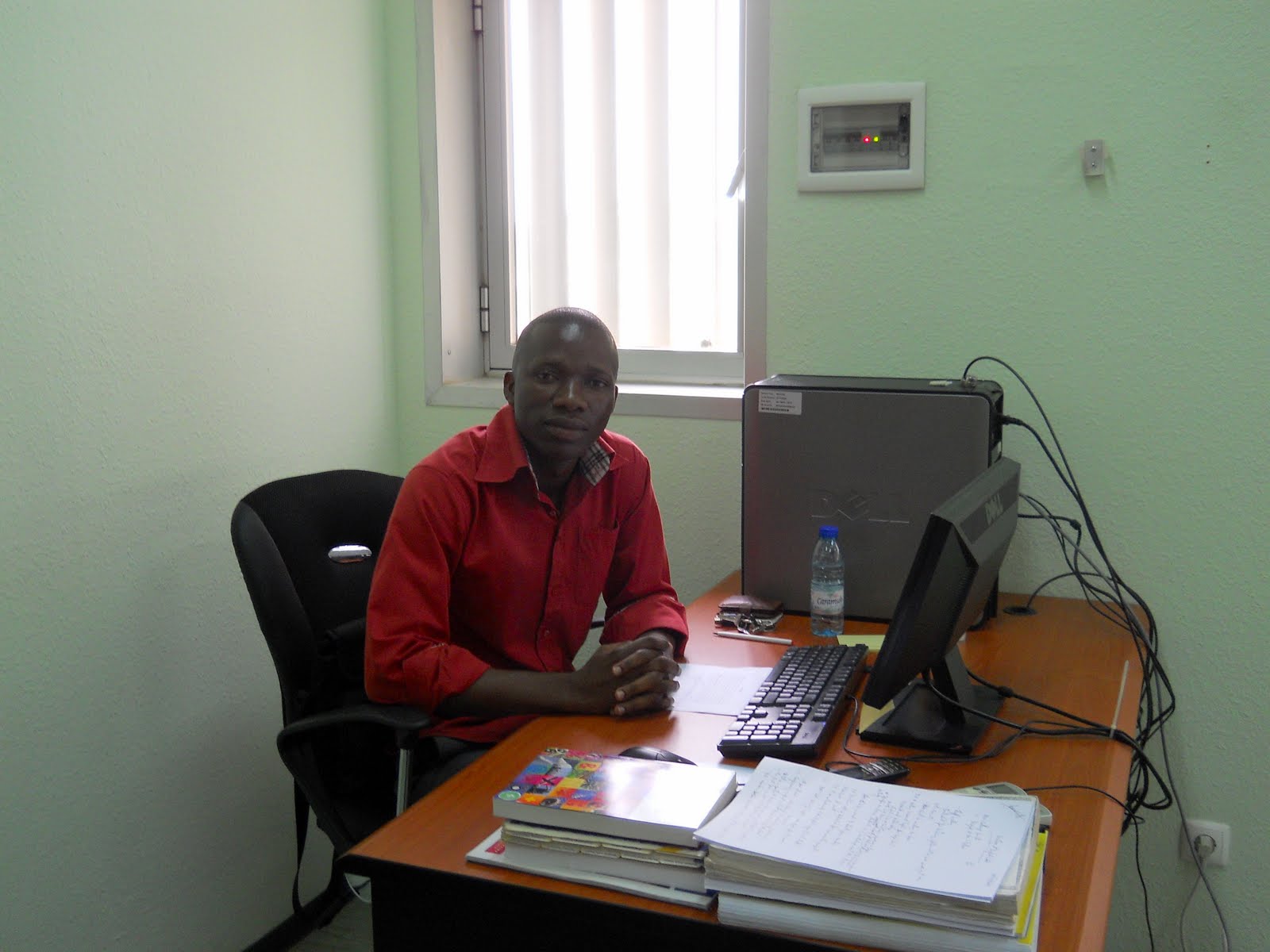
The primary goal of my fellowship is to improve the English program at Universidade Agostinho Neto. I will be teaching 2 courses at the university and also working wth the head of the English Dept. on the curriculum. AMEC recently renovated the English Dept. office at the university. It's incredibly modern for this city.


My colleague at the university, Rocha


The other aspect of my job is community involvement. The embassy has English programs at schools in the most impovershed areas of the city. Starting next week, I'll be spending time with the kids there, assessing the programs, and ordering English materials.